Hammersmith & Fulham Development Finance 2026: White City Life Sciences, Earls Court Masterplan & The Fulham Premium Correction
Hammersmith & Fulham is down 7.8% year on year in February 2026 (HM Land Registry), against a Greater London headline of -3.3%. That puts the borough 450 basis points below the regional benchmark — the third-deepest correction in the capital, behind only its prime central neighbours Kensington and Chelsea at -11.2% and Westminster at -10.8%. But H&F is not a sister prime central borough. It is a premium-leaning west-London regen borough being repriced by what is happening next door, with a structural pipeline through White City, Earls Court and Shepherd’s Bush that K&C cannot match.
The story underneath the borough number is four sub-zone economies running concurrently. Fulham riverside is the borough’s premium domestic anchor, correcting closer to the K&C pace because the lender pool prices it on Chelsea-adjacent comparables. Hammersmith Town is the mixed-use mid-rise resi-led core, currently held back by the Hammersmith Bridge rebuild as a value-suppressor that should reverse 2027-28. White City is the borough’s structural growth zone — the Imperial College campus, the BBC TV Centre conversion, the Westfield London anchor and the wider life-sciences cluster. Earls Court is the cross-borough masterplan with K&C — roughly 4,000 homes consented through the Earls Court Development Company. Four sub-zone economies. One borough number.
Why Hammersmith & Fulham is the west London regen story under the prime correction
Most London boroughs respond to the prime central correction either as part of it (K&C, Westminster) or insulated from it (Wandsworth, Walthamstow). H&F responds to it as a premium-leaning fringe — the borough takes the repricing on its Fulham riverside stock the way a Chelsea-adjacent borough has to, but it carries a structural pipeline through White City, Earls Court and Shepherd’s Bush that gives the lender pool somewhere institutional to deploy capital while the prime correction works through.
That is the structural difference between H&F at -7.8% and K&C at -11.2%. Same lender pool. Same prime correction zone for capital allocation purposes on the southern half of the borough. But three percentage points shallower because the northern half is in active build with institutional take-out underwriting, and one of the largest single-borough regen pipelines in west London is currently absorbing capital that K&C has nowhere to absorb.
The Imperial College White City Campus is the structural anchor. Roughly £800m of life-sciences and innovation forward-fund pipeline is concentrated on the campus itself and the immediately adjacent BBC TV Centre conversion footprint. Net yields on credible Imperial-adjacent life-sciences plots are clearing 4.5 to 5.0% — sharper than typical BTR forward funding because institutional life-sciences appetite is structurally stronger than open-market resi appetite in 2026. That is the borough’s standout finance story.
The Earls Court masterplan is the second. The Earls Court Development Company has roughly 4,000 homes consented across the cross-borough footprint, with delivery sequenced through 2026 to the early 2030s. Senior debt at 65 to 70% LTGDV at 6.5 to 7.0% on credible Earls Court phase work is what makes the masterplan financeable through the correction window. The institutional underwrite carries the capital stack across the prime correction in a way no individual K&C scheme can.
Reading the -7.8% in context
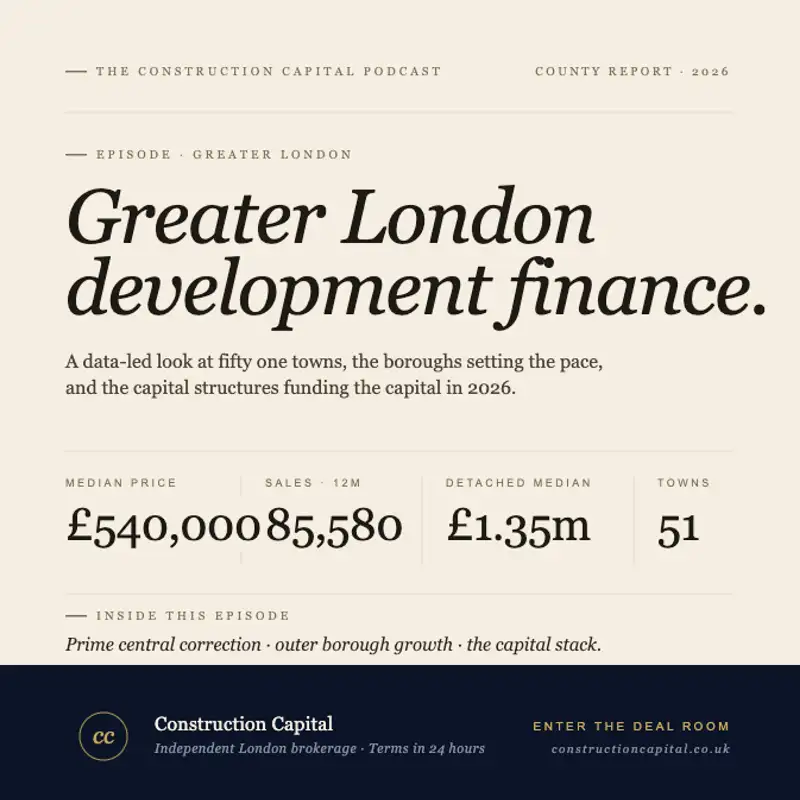
Greater London’s headline house-price index fell 3.3% year on year in February 2026 to a regional median of around £542,000 across roughly 85,580 transactions in the rolling twelve months. New-build completions ran at just 1.9% of total activity. H&F’s -7.8% is 450 basis points below the regional benchmark.
The deepest correction is K&C at -11.2%, with Westminster at -10.8% — the prime central pair. H&F at -7.8% sits between the prime central correction zone and the broader inner-west-London market. Camden is at -6.4%, the inner-north sister borough on the diversified-stack model. Wandsworth is at -3.0% on the south side of the river, sister south-west regen borough that has Battersea / Nine Elms absorbing the institutional flow on the south bank. Westminster is the closer comparable in lender behaviour — the prime correction zone with structural regen capacity. K&C is the closer comparable on the southern Fulham half of the borough — the prime resi correction without an offsetting regen pipeline.
The H&F-K&C spread is 340 basis points. Most of that gap is the White City life-sciences pipeline plus the Earls Court masterplan absorbing institutional capital that K&C has no equivalent for. The H&F-Westminster spread is 300 basis points. Most of that gap is the borough being one tier down on the prime international super-prime concentration — H&F has nothing equivalent to Mayfair or Belgravia, and the Fulham riverside stock at £1,000 to £1,400 per square foot is structurally less exposed to the international ultra-HNW demand swing than the Mayfair-Belgravia stock at £2,000 to £4,000 per square foot.
The H&F-Wandsworth spread across the river is 480 basis points. That is roughly the spread between a premium-leaning fringe-prime borough being repriced by the K&C correction next door and a south-west London regen borough with Nine Elms absorption on its side of the bridge. Same institutional capital pool. Different sub-borough exposure mix.
The sub-zone anatomy: Fulham riverside, Hammersmith Town, White City, Shepherd’s Bush, Earls Court (cross-borough), Olympia
Fulham (SW6). The borough’s premium domestic anchor. East Fulham, Central Fulham, West Fulham, Sands End, Parsons Green. Bishop’s Park, Fulham Palace, the Thames frontage between Putney Bridge and Wandsworth Bridge. Stamford Bridge (Chelsea FC). Edwardian and Victorian terrace stock at the £1,000 to £1,400 per square foot range. The lender pool prices Fulham on Chelsea-adjacent comparables, and the correction reflects that — likely closer to -10% on the riverside premium stock specifically, with the Parsons Green and East Fulham mid-tier holding closer to the borough average. Bridging-led value-add reposition at 0.65 to 0.85% per month is the dominant capital flow on the Edwardian / Victorian terrace stock.
Hammersmith Town (W6). Commercial centre, mid-rise resi-led. Eventim Apollo, Riverside Studios, Hammersmith Broadway, the King Street commercial corridor. The Hammersmith Bridge rebuild is the active value-suppressor — the bridge has been closed to motor vehicles since 2019 and the rebuild is now in active construction, with a target reopening of late 2027. That has shaved 8 to 12 percentage points off the south-of-the-bridge resi values that are currently cut off from the Putney / Barnes catchment. The reversal trade is the structural opportunity — once the bridge reopens in 2027-28, that value suppression unwinds. Senior debt at 65% LTGDV at 6.75 to 7.25% on credible mid-rise resi-led schemes.
White City (W12). The borough’s structural growth zone. Imperial College White City Campus (life-sciences, innovation, postgraduate), BBC TV Centre conversion (BBC retained, Stanhope-led mixed-use redevelopment delivered through 2017-2024 with continuing absorption), Westfield London (the largest urban shopping centre in Europe by retail floor area), White City Place. Central Line, Hammersmith & City Line, Overground at Shepherd’s Bush. The active life-sciences forward-fund pipeline is concentrated here — net yields 4.5 to 5.0%, sharper than typical BTR because the institutional life-sciences appetite into the Imperial catchment is structurally stronger than open-market resi appetite in 2026.
Shepherd’s Bush (W12). The mid-tier resi-led growth corridor. Shepherd’s Bush Green, the W12 high street footprint, the Wood Lane corridor (linking Shepherd’s Bush to White City). Central Line, Hammersmith & City Line, Overground (Shepherd’s Bush station), Crossrail-fringe via Tottenham Court Road interchange (Shepherd’s Bush to TCR is 9 minutes on the Central Line, then a single seat to Heathrow). Mid-rise resi-led schemes finance at 70% LTGDV at 6.5%. The most consistently financeable mid-rise consents in the borough by deal count.
Earls Court (SW5, cross-borough). Single masterplan shared with K&C across the borough boundary. Earls Court Development Company has roughly 4,000 homes consented across the wider footprint, sequenced through 2026 to the early 2030s. The largest single-scheme GDV in west London inner. Senior debt at 65 to 70% LTGDV at 6.5 to 7.0% on credible Earls Court phase work — financed on cross-borough institutional underwrite that prices the masterplan independently of either borough’s headline correction. Selected phases have BTR forward-fund commitments at 5.0 to 5.5% net.
Olympia (W14). Convention centre redevelopment. Olympia London (Yoo Capital / Deutsche Finance redevelopment) reopened in late 2024 / 2025 as a mixed-use complex anchored by the convention venue, theatres, hotel, performance space and adjacent resi-and-office release. Active conversion absorption phase through 2026. Selective resi-led conversion finance available at 65% LTGDV at 7.0% on credible mixed-use elements.
Wormwood Scrubs / North Pole / Brookwood corridor (W12 / NW10). Old Oak Park Royal opportunity area fringe. The borough’s slice of the wider OOPR masterplan footprint sits along the northern boundary with Brent. Long-end optionality on the OOPR delivery curve, currently early-stage from a deal-flow perspective.
Why White City is the borough’s structural growth zone (and what 4.5-5.0% life-sciences forward-fund yields mean)
The Imperial College White City Campus is the largest single life-sciences and innovation campus in inner west London. Imperial has been progressively shifting research and postgraduate footprint to White City since 2016, with the Molecular Sciences Research Hub, the Sir Michael Uren Hub (life-sciences and engineering), the I-HUB innovation centre, the Wood Lane Studios postgraduate accommodation and the Translation & Innovation Hub all now operational. The wider campus delivery curve runs through the late 2020s and early 2030s.
The institutional life-sciences forward-fund market in the UK in 2026 is structurally tight. Cambridge, Oxford and west London Crick / White City are the three institutionally-recognised clusters that command the sharpest yields. White City sits in the inner-London segment with material yield compression versus generic mixed-use forward funding. Net yields on credible Imperial-adjacent life-sciences plots are clearing 4.5 to 5.0%. That is 50 to 100 basis points sharper than typical BTR forward-fund yields in the inner-west London cluster.
What that means for the appraisal: a White City life-sciences plot priced on a 4.75% net yield supports a materially higher residual land value than the same plot priced on a 5.5% open-market BTR net yield, and senior debt on a forward-funded life-sciences scheme prices 25 to 50 basis points tighter than the equivalent BTR construction loan because the take-out is institutional and effectively underwritten on Imperial’s covenant strength alongside the operator. That is the structural reason White City has continued to attract capital through the 2026 correction window when surrounding Fulham and Hammersmith new-build origination has thinned out.
The BBC TV Centre conversion (delivered through 2017-2024 by Stanhope and partners, retaining the BBC’s W12 footprint while releasing the wider site for mixed-use redevelopment) is in the absorption phase. Active resi-led units, hotel, restaurant and ancillary commercial. The conversion sits adjacent to the Imperial campus footprint and forms part of the wider White City institutional cluster. Westfield London anchors the retail and footfall economics.
What lenders are pricing on H&F schemes in 2026
Following the Bank of England’s December 2025 cut to 3.75%, the all-in capital stack on a typical H&F scheme is split-tier across the borough. The split runs along the prime correction line — Fulham riverside and Hammersmith Town are priced on the inner-prime correction zone; White City, Shepherd’s Bush, Earls Court masterplan phases and Olympia conversion are priced on the structural-zone / regen-zone band.
Senior development finance on a Fulham or Hammersmith Town resi-led new-build scheme is pricing 6.75 to 7.25% per annum at 65% LTGDV. Five percentage points tighter on leverage than connected outer London, 50 to 75 basis points wider on margin. That sits between the K&C / Westminster prime correction zone (60-65% LTGDV, 7.0-7.5%) and the inner-west growth band (70% LTGDV, 6.5%). On a Shepherd’s Bush mid-rise resi-led scheme the pricing improves to 70% at 6.5% — closer to the connected outer band because the borough’s mid-tier resi-led catchment behaves more like a Wandsworth or Camden mid-rise scheme than a Fulham riverside scheme.
Senior debt on Earls Court masterplan phase work prices at 65 to 70% LTGDV at 6.5 to 7.0% per annum, depending on the BTR vs open-market resi mix in the phase and the institutional take-out structure. The cross-borough institutional underwrite carries the masterplan capital stack across the prime correction in a way no individual K&C scheme can. Selected phases have BTR forward-fund commitments locking the take-out at 5.0 to 5.5% net.
Mezzanine finance prices at 12 to 13% per annum, layered to 85 to 90% of cost. The mezz pool is selective on Fulham townhouse value-add — the per-unit ticket sizes work but the trajectory exposure on the Chelsea-adjacent stock is being priced cautiously through the correction window. JV equity providers are demanding 22 to 26% IRR targets on H&F resi-led — wider than Wandsworth (18 to 22%) but tighter than K&C (22 to 28%).
Bridging loans remain very active in the borough. The Fulham townhouse value-add market in particular is one of the most consistent bridging deal-flow corners of inner-west London — Edwardian and Victorian stock at £1.5m to £4m, refurb-to-rent or refurb-to-sell, 9 to 14 month construction window. Bridging at 0.65 to 0.85% per month at up to 75% LTV is the standard structure. Hammersmith Town townhouse and Hammersmith Town flat reposition is the second-largest bridging corner.
The structurally active institutional product is twofold. White City life-sciences forward funding at 4.5 to 5.0% net yield. And BTR forward funding on Earls Court phases and Shepherd’s Bush mid-rise at 5.0 to 5.5% net. Together these absorb a meaningful share of the borough’s 2026 senior debt capacity at near-Wandsworth pricing — and that is the structural reason H&F has more financed activity than K&C in 2026 despite both sitting in the prime correction zone.
The Earls Court masterplan — a single cross-borough scheme
The Earls Court Development Company (ECDC) holds the wider Earls Court footprint with K&C and H&F as joint planning authorities across the cross-borough boundary. The wider masterplan supports roughly 4,000 homes consented in phases over the long run, plus commercial, cultural, retail and amenity uses. The largest single-scheme GDV in inner west London inner.
Phase delivery is sequenced through 2026 to the early 2030s. The institutional take-out is structured around BTR forward funding for the higher-density phases and open-market resi sale for the mid-rise phases, with senior construction debt sized against the phase-level capital stack rather than the masterplan-level GDV. Senior debt at 65 to 70% LTGDV at 6.5 to 7.0% per annum on credible Earls Court phase work is what makes the masterplan financeable through the correction window.
The cross-borough institutional underwrite is the structural feature. The lender pool prices the Earls Court phases on the masterplan absorption profile rather than on either borough’s headline correction — that means the K&C -11.2% and the H&F -7.8% feed into the underwriting only as comparable inputs, not as the phase-level appraisal anchor. Selected phases have BTR forward-fund commitments locking the take-out at 5.0 to 5.5% net, which compresses senior pricing on the construction layer by 25 to 50 basis points relative to an open-market resi structure.
What is actually transacting in H&F
Five categories of scheme are running across the borough in 2026.
White City life-sciences forward funds. The dominant institutional product by yield-tightness. Imperial-adjacent and BBC TV Centre fringe schemes. Net yields 4.5 to 5.0%. Senior construction debt on a forward-funded life-sciences scheme prices at 6.0 to 6.5% per annum at 65 to 70% LTGDV — tighter than the equivalent open-market resi structure because the take-out is institutional.
Earls Court masterplan phase work. The largest single-scheme GDV in west London inner. Cross-borough institutional underwrite. Senior at 6.5 to 7.0% at 65 to 70% LTGDV. Selected phases with BTR forward-fund commitments at 5.0 to 5.5% net.
Fulham value-add reposition. Bridging-financed at 0.65 to 0.85% per month. Edwardian and Victorian terrace stock between £1.5m and £4m. The single largest bridging deal-flow corner of inner-west London by deal count. Refurb-to-rent or refurb-to-sell windows at 9 to 14 months.
Shepherd’s Bush mid-rise resi-led. Senior at 6.5% at 70% LTGDV on credible 60 to 200 home mid-rise resi-led schemes. The most consistently financeable mid-rise consents in the borough by deal count outside of the Earls Court masterplan.
Olympia mixed-use conversion absorption. The Yoo Capital / Deutsche Finance Olympia London redevelopment is in active absorption through 2026. Selective resi-led conversion finance available at 65% LTGDV at 7.0% on credible mixed-use elements. Smaller deal-flow corner but the conversion product is well-defined.
What is much smaller in 2026: ground-up new-build resi-led origination on rare consented sites in the Fulham riverside premium band. The capital stack on a fresh super-prime new-build start now requires meaningful equity (35%-plus of cost), a strong sponsor track record specifically in the Chelsea-adjacent market, and a clear product differentiation argument that the lender can underwrite the trajectory through. That deal flow is real but small.
How the capital stack works on a £40-60m GDV H&F life-sciences / BTR scheme
A typical mid-cap White City life-sciences forward-funded scheme at this scale, with strong PTAL within a 10-minute walk of the Central Line at White City or Wood Lane, an Imperial-adjacent or BBC TV Centre fringe location, a credible operator commitment and a clean planning consent under the new NPPF regime, can be financed with senior development finance at 65 to 70% LTGDV (around 6.0 to 6.5% per annum), mezzanine layered to 85 to 90% of cost (12% plus), and an institutional life-sciences forward-fund commitment locking the take-out at 4.5 to 5.0% net yield. The forward-fund commitment compresses senior pricing on the construction layer by 25 to 50 basis points relative to an open-market resi structure of the same scale, because the back-end exit risk is materially de-risked.
Blended cost-of-funds on a forward-funded White City life-sciences scheme can sit in the high sixes to low sevens — meaningfully tighter than the equivalent open-market resi structure. That is the operative argument for the life-sciences product on the Imperial White City catchment specifically.
On an Earls Court masterplan phase BTR-led scheme of the same scale, the structure is similar but priced 25 to 50 basis points wider on the senior layer — senior at 65 to 70% LTGDV at 6.5 to 7.0% per annum, mezzanine to 85 to 90% of cost at 12% plus, BTR forward-fund take-out at 5.0 to 5.5% net. Blended cost-of-funds in the high sevens. Tighter than a Fulham or Hammersmith Town open-market resi structure because the institutional take-out de-risks the back end.
On a Fulham riverside value-add reposition or a Hammersmith Town mid-rise resi-led scheme of the same scale, the structure shifts to senior at 65% LTGDV at 6.75 to 7.25% per annum, mezzanine selectively at 12 to 13% per annum, and an open-market resi take-out underwritten on Chelsea-adjacent or Hammersmith mid-tier comparables. Blended cost-of-funds in the high sevens to low eights. Open-market exit risk on the back end, which is the structural reason the lender pool prices Fulham riverside more cautiously than White City life-sciences in 2026.
What this means for site acquisition
If you are pricing land in H&F in 2026, three things matter more than they have in any recent cycle.
One, the sub-zone is the appraisal, not the borough. A White City life-sciences forward-fund plot runs on a 4.5-5.0% net yield with institutional underwrite. An Earls Court masterplan phase runs on cross-borough institutional underwrite priced independently of either borough’s headline correction. A Fulham riverside townhouse reposition runs on Chelsea-adjacent comparables in the prime correction zone. A Hammersmith Town mid-rise scheme runs on inner-west mid-tier comparables held back by the Hammersmith Bridge rebuild. A Shepherd’s Bush mid-rise scheme runs on inner-west growth comparables. Same borough, multiple valuation models, materially different residual land values. Underwriting all of them is the discipline.
Two, the institutional product (White City life-sciences at 4.5-5.0% net yield, Earls Court BTR forward fund at 5.0-5.5%) is in the institutional sweet spot for inner west London and is the structural product the borough is optimised for through 2025 to 2030. If you have a White City plot that supports the life-sciences yield calculation with credible operator commitment, or an Earls Court phase that supports the BTR forward-fund yield calculation with rental tone and operational delivery economics, that is a financeable product on better terms than an open-market resi structure on the same plot.
Three, the Hammersmith Bridge reversal trade is the borough’s structural opportunity through 2026-2028. The bridge rebuild is in active construction with a target reopening of late 2027. The 8 to 12 percentage points of value suppression currently sitting on south-of-bridge Hammersmith resi values unwinds when the catchment to Putney / Barnes is restored. Bridging-financed value-add reposition acquired in 2026 against a 2027-28 exit is the cleanest play on the reversal. The post-NPPF planning regime, the Mayor’s emergency package and the Time-Limited Planning Route together favour H&F schemes that move quickly through to delivery.
For full borough-by-borough sold price data, the White City life-sciences pipeline references, the Earls Court masterplan phasing detail and the underlying capital stack benchmarks behind this analysis, see the Greater London Property Market Report 2026. Borough-specific intelligence sits on the Hammersmith & Fulham location page.
See also: Walthamstow +5.9% on YouTube and The £650/sq ft Cliff on YouTube.
Listen to the full episode
For the dedicated deep dive on this borough, we have published a stand-alone Hammersmith & Fulham episode of the Construction Capital podcast: Hammersmith & Fulham -7.8%: White City Life Sciences, Earls Court Masterplan and the Fulham Premium Correction. Around ten minutes covering the four-sub-zone read, the White City Imperial life-sciences forward-fund yields, the Earls Court Development Company masterplan, the Hammersmith Bridge reversal trade, the full April 2026 capital stack, and what is actually transacting in 2026.
This article also draws on Episode 2 of the Construction Capital podcast: Greater London Property Development Finance 2026: Market Analysis, House Prices and Lending Outlook. The full borough-level data, policy detail and capital stack discussion runs 15:30, with chapters covering Walthamstow, Bromley, Hackney and the inner-west boroughs within the wider Greater London outlook.
Listen anywhere
Listen on Apple Podcasts, Spotify, Overcast, Pocket Casts, or Amazon Music.
For indicative terms on a Hammersmith & Fulham scheme within 24 hours, submit through the Construction Capital deal room. Construction Capital sources terms from over 100 lenders across development finance, bridging, mezzanine and equity.
Published by Construction Capital, an independent capital advisory brokerage sourcing terms from over 100 lenders across development finance, bridging, mezzanine, and equity. This article is part of the Greater London 2026 series accompanying the Construction Capital podcast.